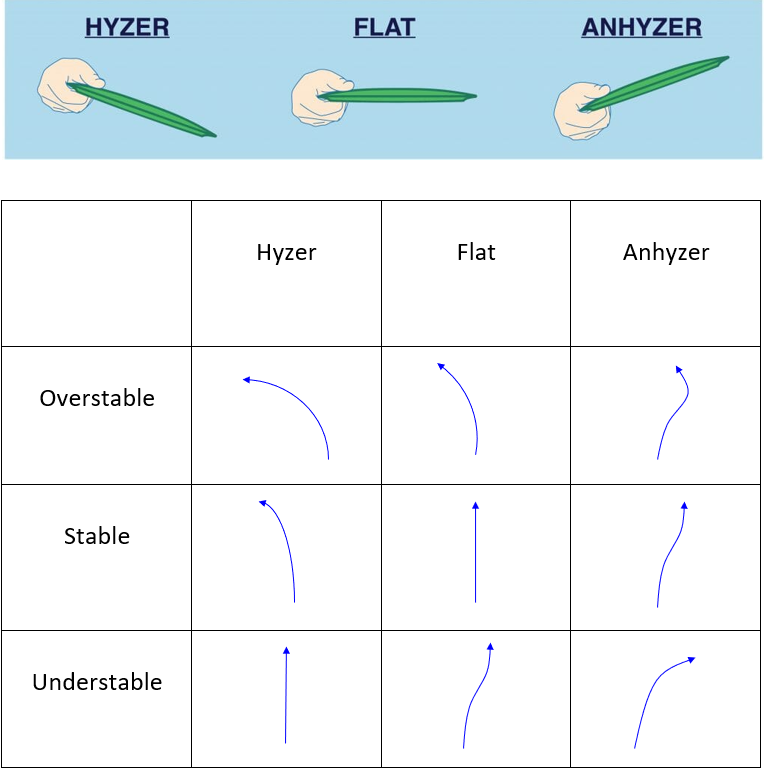
Right-Handed BackHand (RHBH) is the most common throw for beginners unless you are left-handed. Most discs tend to fade left at the end of a RHBH throw due to physics; if you throw a Right-Handed ForeHand (RHFH) it will fade right at the end. This is mirrored for a left-handed thrower.
| SPEED |
|---|
How fast the disc must be thrown for the other numbers to apply; correlated with rim width (wider rim → higher speed).
| 1 to 3 | Putters | Very stable and accurate due to their slower speed and more controllable flight. Typically easier to make into the basket. |
| 4 to 5 | Midranges | Relatively straight flight path while still being able to fly farther than a putter. |
| 6 to 9 | Fairway Drivers | Balanced for accuracy and distance. |
| 10 to 14+ | Distance Drivers | Cut through headwinds best but need pro-level snap/power (400+ ft arm speed) or they'll dump early/turn too much. |
Key Details:
Speed doesn't directly mean distance — a low-speed, high-glide disc can outfly a high-speed, low-glide disc for most players. Match discs to your arm speed and test with field throws (i.e. beginners should not throw distance drivers).
| GLIDE |
|---|
How well the disc stays in the air (loft).
| 1 to 3 | Control | Drops quickly. Precise for approaches, wind resistance, full-power short shots. Less affected by gusts. |
| 4 to 7 | Distance | Floats far, maximizes distance for beginners/average arms. Risky in headwinds (stalls) or for over-powering (overshoots). |
Key Details:
Glide shines at optimal speed - too slow, it fades early; too fast, it turns more. Lightweight discs glide more.
| TURN |
|---|
Indicates the disc's tendency to move in the direction of its spin during the fastest part of the flight (right after it leaves your hand). For a RHBH this would mean to turn right. This is the disc's High-Speed Stability (HSS).
| +1 to 0 | Overstable/Stable | Resists turning right, flies straight, or fades left early. |
| -1 to -5 | Understable | Turns right during the high-speed phase of the flight. |
Key Details:
Turn activates at/above rated speed;
Slower throws = less/no turn. If you throw a disc faster than its rated speed, it will exhibit more turn (it will turn over to the right more than the number suggests).
Wind amplifies: tailwind reduces, headwind increases.
Use negative turn for shaping shots around obstacles.
| FADE |
|---|
Indicates the disc's tendency to move against the direction of its spin during the slowest part of the flight (towards the end of the throw). For a RHBH this would mean to turn left. This is the disc's Low-Speed Stability (LSS).
| 0 to 2 | Stable/Overstable | Finish straighter or with a gentle, soft landing. A disc with a Fade of 0 is designed to land as straight as possible. |
| 3 to 5 | Overstable | Provide a very predictable, strong finish, making them great for headwinds or shots requiring a sharp hook. |
Key Details:
Fade starts later/harder with nose-down releases; earlier if underpowered. High fade = reliability for pros.
High fade discs are usually used for Spike and Skip shots.
| STABILITY |
|---|
A disc is said to be stable if it lands straight ahead of where it was thrown.
Assume we have a birdseye view, for a RHBH thrower the disc did not fade left nor turn right relative to the direction the player threw the disc.
| Stability = Turn + Fade |
A brand-new disc with flight numbers 7/5/-2/2 will, when thrown straight ahead with enough power, turn right during the intial part of the flight, then fade left during the final part of the flight, and land straight ahead of the direction the player threw it.
Despite this non-straight, S-curve flight path this disc is said to be stable (if it wasn't new and the rim was dinged up it will likely turn right more, resulting it being an understable disc).
Here is an image and links to help with the explanation.
|
Example: Innova Leopard (6 / 5 / -2 / 1) Easier for a beginner to throw, reaches far, turns right, gentle finish left. Stability = -2 +1 -> Understable disc |
|---|
More of My Disc Golf Articles